


Tales from the Silk Trail
- Jul 13, 2018
- 4 min read

Coming from a typical south-Indian family, every household wedding initiated an elaborate trip to Kancheepuram, to buy the best ‘mughurtha podavai’ for the blushing bride-to-be. As a young kid, this only mean nice day in another town, running across the narrow aisles as the women gushed over row upon row of colourful sarees. Now, as I step through the various distinct phases on a Silk trail, I finally understand what all the fuss was about.
Kancheepuram silk sarees have a history and profundity as rich as their appearance. Often considered heirlooms, these sarees range in cost from Rs.8,000 to over 1 Lakh depending on the weight, design and quantity of zari. A silk saree passes through several hands before you buy it at the retail store. The silk and zari threads are processed separately, and reach the co-operative society from where, based on designer’s expertise, the silk yarn and zari are distributed to respective weavers. Once the sarees are woven, they are returned back to co-op society which then sends them to retail stores. Kancheepuram has both co-operative (government-owned) as well as private silk saree dealers. The silk handloom industry forms a major part of the town’s economy.
What's in a Kancheepuram saree
A saree is made by hand-weaving silk and zari threads in an elaborate process. They are known for their strength and durability, made possible by the twisted yarn - double warp and double weft, which gives it the weight. In a typical Kancheepuram saree, the main body, and pallu and border are woven separately resulting in a ’korvai’ or visible zig-zag stitch that runs parallel to edge of the border and pallu. This joint is woven very strongly and is what differentiates the Kancheepuram silk sarees from the others. Nowadays, however, the body, border and pallu are woven together, and different colours border and pallu is achieved by tie-and-dye method, wherein a single silk warp is dyed in different colours.
Raw silk is rough and sticky in texture, and needs to undergo a series of processes before it becomes as fine and shiny as we know it. Raw silk yarn is received from the co-operative society. Based on the saree designs, yarn loops are de-gummed, dyed and dried before sending them back to co-operative societies to be distributed to respective weavers. The raw silk is rinsed thoroughly in normal water to remove dirt and soften the silk before de-gumming. Water is heated to up to 90 degrees in a boiler and the steam thus produced is sent through pipes to each trough of water.


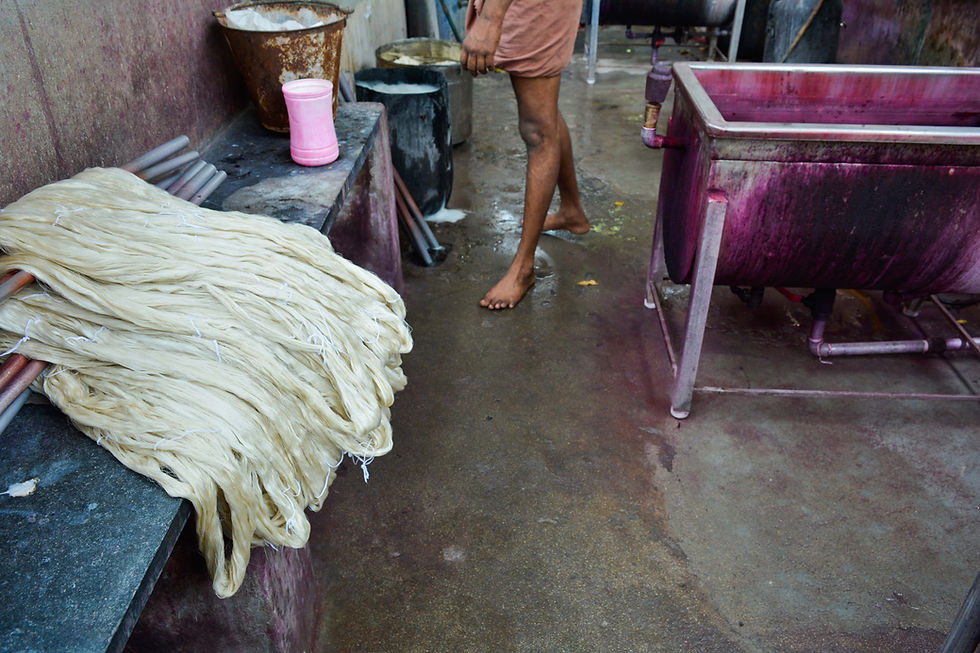


The wet silk is immersed in boiling hot water mixed with soap and soda in order to remove the roughness and dirt. This process takes up to 30 minutes, during which Sekar and Mani constantly stand by in the searing hot humid set-up and periodically twist and rotate the silk yarn with the rods to ensure even de-gumming. Finally, the silk yarns are taken out, twisted dry and kept aside. In one turn, about 6 kg of silk is degummed. In a day, they manage to do over 70 kg.
The process of dying usually takes about 15 minutes, based on the colour. Originally, natural dyes were used, but now chemical acid or metal complex dyes are used. Similar to de-gumming, the yarn is immersed in a trough filled with boiling dye-infused water and periodically rotated to ensure even colouring.
The rich dyed silk yarn loops are removed, and after a while washed in a normal water bath. They are then soaked in a fixing agent (for lighter colours, lime juice is used) and finally the silk yarn is spun in a machine to remove all moisture and laid out to dry in the sun for about 2-3 hours, after which it is bundled and sent back to the co-op society office. This whole process imparts a soft sheen texture to the silk threads.

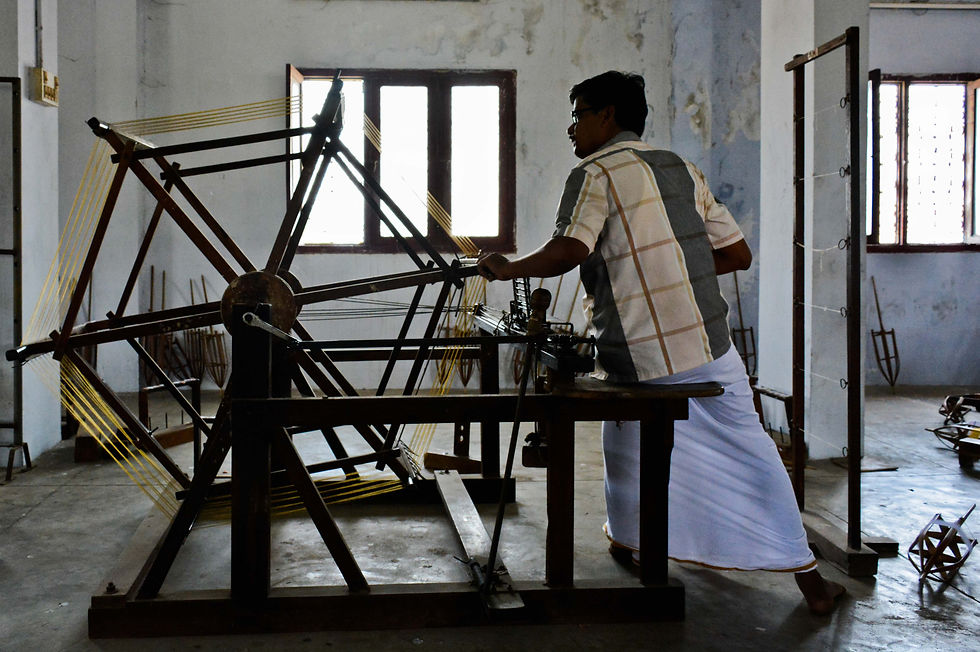


Zari is essentially a silk thread coated with silver (50-55%) and gold (0.5%), and is the most expensive element of the Kancheepuram saree. Previously Zari was imported from Gujarat, but now Zari processing units have been opened in the region to cater to increasing demand. Weavers measure and collect required amount of Zari according to their saree’s design, in the form of warps or wefts, from the co-operative society. Sarees vary in zari quaintly from 10% to about 60% – cost of saree is directly proportional to zari quantity.


Weaving a Kancheepuram saree is a complex process and takes anywhere between 5 to 30 days. Every saree is woven by double warp (threads along length of the saree) and double weft (shorter threads along the shorter length of the saree), the combination of which provides the weight and strength to the saree. The warps are stretched across the handloom, while the weft is inserted by hand using shuttles. The threads used in weaving are in fact three threads twisted together, which adds to the strength. In the case of small butta, motifs in the body, Pallu and border, the weft consist of zari threads, instead of silk. For preparing a traditional double side contrast border silk saree, three shuttles are used, which requires an extra semiskilled labourer.
Comments